
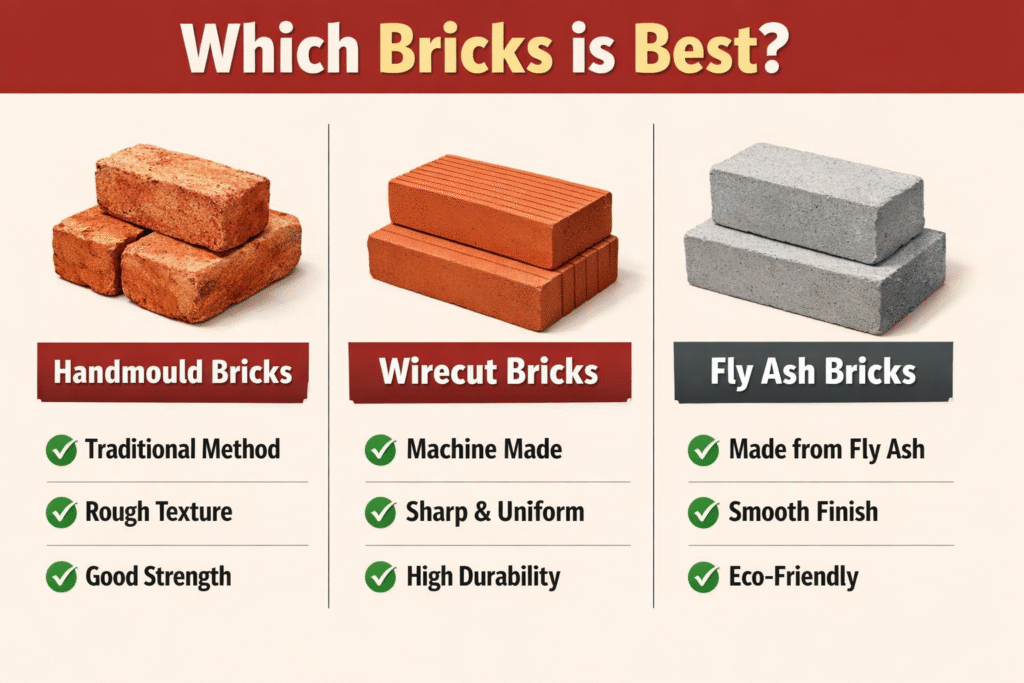
A Complete Comparison of Wirecut Bricks, Handmould Bricks, and Fly Ash Bricks
When a building project is planned, attention is usually given to cement, steel, and design. However, one of the most important materials—bricks—is often chosen without proper comparison. Since bricks form the foundation and walls of a structure, their quality directly affects strength, durability, and appearance. Among all options available today, red bricks continue to be the most trusted and widely used material in construction.
Although red bricks have been used for generations, different types are now available, such as wirecut bricks, handmould bricks, and fly ash bricks. Therefore, a common question is frequently raised: which bricks are best for construction?
In this blog, a detailed and easy-to-understand comparison is provided to help make the right choice.
Why Red Bricks Are Still Preferred in Construction
Firstly, red bricks are made from natural clay, which is abundantly available. Secondly, high durability is achieved through kiln firing at elevated temperatures. As a result, long service life and structural stability are ensured.
Moreover, bricks are known for:
- Excellent compressive strength
- Good thermal insulation
- Resistance to weather changes
- Natural aesthetic appeal
Because of these benefits, bricks are still preferred for residential, commercial, and traditional buildings.
Types of Red Bricks Commonly Used Today
Red bricks used in construction are generally classified into:
- Wirecut Bricks
- Handmould Bricks
- Fly Ash Bricks (alternative, often compared with red bricks)
Each type differs in manufacturing method, finish, cost, and application. Therefore, understanding these differences is essential.
Wirecut Bricks – Modern Precision and Strength
What Are Wirecut Bricks?
Wirecut bricks are manufactured using automated machines. Clay is extruded into a column and then cut using steel wires. After that, bricks are fired in kilns under controlled conditions.
Because of this process, uniform shape and size are achieved.
Advantages of Wirecut Red Bricks
Firstly, dimensional accuracy is maintained, which results in neat brickwork. Secondly, mortar consumption is reduced due to uniformity. Additionally, high compressive strength is achieved because of dense firing.
Furthermore, wirecut bricks are ideal for:
- Modern houses
- Apartments and villas
- Load-bearing structures
Limitations of Wirecut Bricks
However, wirecut bricks are slightly more expensive than handmould bricks. Also, for traditional-style buildings, their smooth appearance may not always be suitable.
Handmould Bricks – Traditional Choice with Timeless Appeal
What Are Handmould Bricks?
Handmould bricks are made using traditional techniques. Clay is manually pressed into moulds and then fired in kilns. Because the process involves manual work, minor size variations are naturally present.
Nevertheless, handmould bricks remain highly popular.
Advantages of Handmould Red Bricks
Firstly, strong bonding with mortar and plaster is achieved due to the rough surface. Secondly, a classic and natural look is provided, which enhances visual appeal.
Additionally, handmould bricks are suitable for:
- Individual houses
- Compound walls
- Traditional and heritage buildings
- Exposed brickwork
Limitations of Handmould Bricks
On the other hand, plaster consumption may be higher due to size variations. Also, construction speed may be slightly slower. However, these drawbacks are often accepted because of their aesthetic value.
Fly Ash Bricks – A Modern Alternative
What Are Fly Ash Bricks?
Fly ash bricks are manufactured using fly ash, cement, and sand. Unlike bricks, kiln firing is not required. Instead, curing is done using water.
As a result, fly ash bricks are considered environmentally friendly.
Advantages of Fly Ash Bricks
Firstly, uniform quality is ensured. Secondly, water absorption is lower compared to traditional red bricks. Moreover, plaster thickness is reduced due to smooth surfaces.
Fly ash bricks are commonly used in:
- High-rise buildings
- Commercial projects
- Large-scale developments
Limitations of Fly Ash Bricks
However, fly ash bricks lack the traditional appearance of red bricks. For exposed walls, they are generally not preferred. Also, availability may be limited in certain regions.
Comparison Table: Wirecut vs Handmould vs Fly Ash Bricks
| Feature | Wirecut Bricks | Handmould Bricks | Fly Ash Bricks |
|---|---|---|---|
| Appearance | Smooth & modern | Rough & traditional | Plain & uniform |
| Strength | High | Moderate to high | High |
| Size Uniformity | Excellent | Slight variations | Excellent |
| Plaster Requirement | Medium | Higher | Low |
| Cost | Medium | Economical | Cost-effective |
| Eco-Friendly | Moderate | Moderate | High |
| Best Use | Modern buildings | Traditional houses | Large projects |
Which Red Bricks Are Best for Your Project?
- For modern residential buildings, wirecut red bricks are often preferred.
- For traditional homes and compound walls, handmould red bricks are considered best.
- For commercial and high-rise buildings, fly ash bricks may be suitable.
Therefore, the best brick depends on design, budget, and construction purpose.
Why Red Bricks Continue to Be the First Choice
Despite new alternatives, bricks continue to be trusted because of:
- Proven performance over decades
- Natural raw materials
- Strong load-bearing capacity
- Adaptability to Indian climate
Because of these reasons, red bricks remain the backbone of construction.
Conclusion
In conclusion, there is no single brick that is perfect for every project. While wirecut bricks offer precision, handmould bricks deliver tradition, and fly ash bricks promote sustainability, red bricks remain the most reliable choice.
Therefore, when high-quality red bricks are selected from a trusted supplier, long-term strength, safety, and satisfaction are assured.