
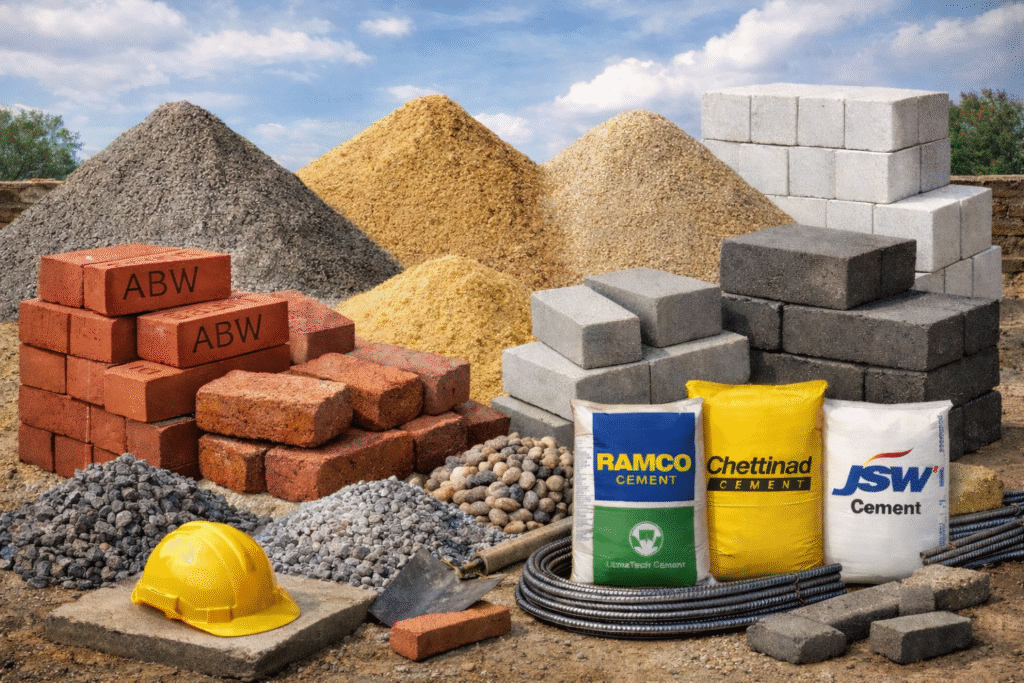
In today’s fast-growing construction industry, the importance of choosing the right building material is often emphasized by experts and professionals alike. From residential homes to large-scale commercial projects, strong and durable structures are ensured only when reliable materials are selected. Therefore, trusted building material suppliers are increasingly relied upon to deliver consistent quality, timely supply, and cost-effective solutions. Moreover, as modern construction standards continue to evolve, materials are expected to meet higher benchmarks of strength, sustainability, and performance. Consequently, a wide range of building materials such as bricks, sand, aggregates, blocks, and cement are now carefully chosen based on application and project requirements. In this blog, a complete overview of essential building materials is presented to help builders, contractors, and homeowners make informed decisions.
Bricks – The Foundation of Strong Construction
Among all construction components, bricks are considered one of the most essential building material choices. For centuries, bricks have been used to create structures that are not only strong but also visually appealing. Even today, bricks are widely preferred due to their durability, load-bearing capacity, and thermal insulation properties. Furthermore, bricks are manufactured in different types to suit specific construction needs. As a result, wirecut bricks, handmould bricks, and fly ash bricks have gained popularity in modern construction practices.
Wirecut Bricks – Precision and Modern Finish
Wirecut bricks are widely used in contemporary construction due to their uniform shape and smooth finish. These bricks are produced by cutting clay columns using wire, which ensures accurate dimensions. Therefore, a neat and modern appearance is achieved when wirecut bricks are used for walls and facades.
Additionally, the strength of wirecut bricks is enhanced through controlled manufacturing processes. As a result, consistent quality is delivered across every batch. These bricks are commonly chosen for residential buildings, commercial complexes, and architectural projects where precision matters.
Moreover, reduced mortar usage is ensured because of their uniform size, which ultimately contributes to cost efficiency. Hence, wirecut bricks are often recommended by building material suppliers for projects requiring clean lines and professional finishes.
Handmould Bricks – Traditional Strength with Natural Texture
In contrast, handmould bricks are known for their rustic appearance and traditional charm. These bricks are manufactured using moulds, which results in slightly uneven edges. Therefore, a natural and timeless look is achieved, making them ideal for heritage buildings and aesthetic construction designs.
Although the production method is traditional, quality is not compromised. On the contrary, handmould bricks are valued for their excellent bonding strength and durability. As a result, they are frequently used in both load-bearing and non-load-bearing walls. Furthermore, these bricks are preferred in regions where climatic conditions demand better heat resistance. Hence, handmould bricks continue to be a trusted building material choice for classic and long-lasting construction.
Fly Ash Bricks – Sustainable and Eco-Friendly Choice
As sustainability becomes a priority, fly ash bricks have been increasingly adopted in modern construction. These bricks are manufactured using fly ash, a by-product of thermal power plants. Therefore, industrial waste is effectively utilized, and environmental impact is reduced.
In addition, fly ash bricks offer high compressive strength and low water absorption. As a result, long-term durability is ensured, and maintenance costs are minimized. These bricks also provide a smooth surface finish, which reduces plastering requirements. Moreover, better thermal insulation is achieved, contributing to energy efficiency. Consequently, fly ash bricks are promoted by many building material suppliers as an eco-friendly alternative to traditional clay bricks.
building Materials – The Backbone of Every Project
Beyond bricks, several other construction materials play a vital role in creating strong and stable structures. These materials are selected carefully to ensure safety, longevity, and compliance with building standards. Therefore, sand, aggregates, blocks, and cement are considered indispensable in construction.
Each material serves a specific purpose, and when used correctly, superior construction quality is achieved. Hence, a deeper understanding of these materials is essential.
M-Sand – Manufactured Sand for Consistent Quality
M-sand, also known as manufactured sand, is produced by crushing hard granite stones. Unlike natural sand, M-sand is manufactured under controlled conditions. Therefore, consistent quality and grading are ensured.
Moreover, M-sand is free from impurities such as clay and silt. As a result, better bonding strength is achieved in concrete and mortar applications. Due to increasing restrictions on river sand mining, M-sand has been widely adopted as a reliable alternative.
Additionally, improved workability and higher compressive strength are delivered when M-sand is used. Hence, it has become a preferred building material for modern construction projects.
P-Sand – Perfect building material for Plastering Works
P-sand, or plastering sand, is specially processed to provide a smooth and fine texture. Therefore, it is primarily used for plastering walls and ceilings. The uniform particle size of P-sand ensures a smooth finish and reduces surface cracks.
Furthermore, excellent bonding properties are achieved, which enhances plaster durability. As a result, finishing quality is significantly improved. Many builders prefer P-sand over traditional river sand for plastering due to its consistency.
Thus, P-sand is considered an essential construction material for achieving flawless interior and exterior finishes.
River Sand – Natural and Time-Tested Material
River sand has been traditionally used in construction for decades. It is naturally sourced and known for its smooth texture and rounded grains. Therefore, good workability is provided in concrete and mortar mixes.
However, due to environmental concerns and government regulations, the availability of river sand has become limited. As a result, it is now used selectively for specific applications where its natural properties are required.
Even so, river sand remains an important building material, especially for specialized construction works.
Aggregates – Strength Providers in Concrete
Aggregates form the bulk of concrete and play a crucial role in determining its strength. These materials include crushed stones, gravel, and coarse particles. Therefore, the load-bearing capacity of structures is directly influenced by aggregate quality.
Moreover, aggregates improve the durability and stability of concrete. Proper grading ensures reduced voids and better compaction. As a result, long-lasting construction is achieved. Thus, reliable aggregates supplied by trusted building material suppliers are essential for strong foundations and structural components.
AAC Blocks – Lightweight and Energy Efficient building material
AAC (Autoclaved Aerated Concrete) blocks have gained popularity due to their lightweight nature and excellent insulation properties. These blocks are manufactured using cement, lime, sand, and aluminum powder. Therefore, a porous structure is created.
As a result, AAC blocks provide superior thermal and sound insulation. Reduced dead load on structures is also ensured, which makes them ideal for multi-storey buildings.
Additionally, faster construction is enabled due to their larger size and ease of handling. Hence, AAC blocks are increasingly chosen as a modern building material solution.
Solid Blocks – Reliable and Load-Bearing building material
Solid blocks are known for their strength and durability. They are commonly used in load-bearing walls and foundation works. Therefore, excellent structural stability is achieved.
These blocks are manufactured using cement, sand, and aggregates, ensuring uniform quality. Moreover, high compressive strength is delivered, making them suitable for heavy construction.
As a result, solid blocks continue to be widely used in residential and commercial buildings.
Cement – The Binding Force of Construction
Cement is considered the most critical building material in construction. It acts as a binding agent that holds all materials together. Therefore, the overall strength of a structure depends heavily on cement quality.
All major cement brands offer products that meet industry standards and quality certifications. These cements are used for concrete, plastering, masonry, and finishing works.
Furthermore, different grades of cement are available for specific applications. As a result, builders can select the right cement based on project requirements. Reliable cement supply ensures consistency and structural integrity.
Conclusion – One Trusted Source for All Building Material
In conclusion, the success of any construction project is determined by the quality of building material used. From bricks and sand to blocks and cement, every material contributes to strength, safety, and durability.